
When manufacturers hear “automation,” the first thought is often labour cost. But in CNC machining, the bigger impact can come from machine utilization, shorter setup times, fewer handling errors and more consistent production – CNC production efficiency.
CNC machining automation is reshaping the production by changing how parts are quoted, scheduled, produced, inspected, and delivered. The biggest gains often come from better machine utilization, fewer manual handoffs, and more consistent process control, not simply replacing labor. This article explains How Automation Is Changing CNC Machining Costs, Lead Times and Quality in practical terms for buyers, engineers, and manufacturers evaluating modern production options.
Automation Is Changing More Than Labour Costs
Modern machining technology can help shops keep spindles cutting for longer periods, reduce setup variation, improve inspection consistency, and move jobs through production with fewer delays.
The real value of CNC machining automation is that it connects tasks that used to happen separately. Programming, tool management, loading, probing, inspection, scheduling, and reporting can all influence the final cost and delivery date. When those steps become more predictable, the entire production process becomes easier to control.
Where Is Automation Used in CNC Machining?
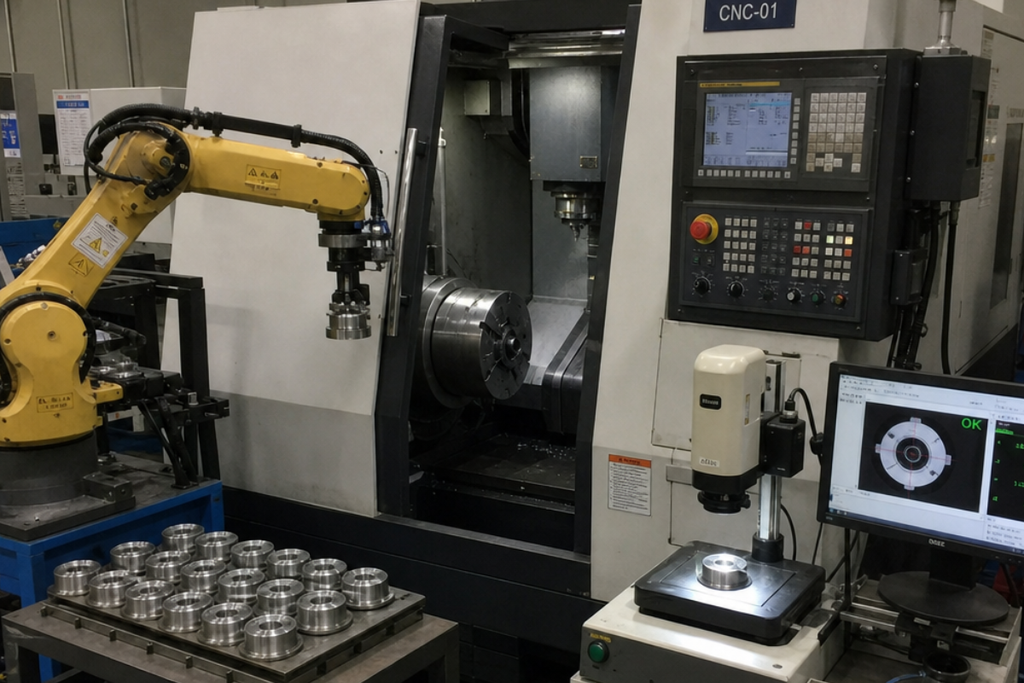
Automation is used across the CNC machining workflow, from pre-production planning to final quality checks. It may involve physical equipment, digital systems, or both. In many shops, the strongest results come from combining several smaller automation improvements rather than relying on one large investment.
Common areas include:
- Robotic machine tending: Robots or pallet systems load and unload parts so machines can run with less operator intervention.
- CAD/CAM programming: Software helps generate toolpaths, simulate machining, and reduce programming errors before metal is cut.
- Tool presetting and management: Automated tool measurement and tracking reduce setup time and help prevent using worn or incorrect tools.
- In-process probing: Machines can measure features during production and adjust offsets before defects multiply.
- Automated inspection: Coordinate measuring machines, vision systems, and digital inspection reports help verify parts more consistently.
- Production scheduling software: Digital planning tools improve workflow visibility and help prioritize jobs based on capacity, material, and due dates.
- Data collection: Machine monitoring systems track uptime, cycle times, stoppages, and utilization to improve CNC production efficiency.
This broader view matters because automated manufacturing is not just about the machine cutting the part. It is about removing friction from every step that affects accuracy, repeatability, and delivery.
How CNC Machining Automation Can Reduce Costs?
Automation can reduce CNC machining costs by increasing machine utilization, lowering rework, shortening setup time, and making labour more productive. The savings are not automatic; they depend on part volume, job mix, process stability, and how well the system is implemented. But when automation fits the work, it can reduce both direct and hidden costs.
One major cost driver is idle machine time. CNC equipment is expensive to own and operate, so every hour a machine waits for loading, setup, inspection, or operator availability affects part cost. Robotic tending, pallet pools, and better scheduling can help machines run longer, including unattended or lightly attended periods.
Automation can also reduce setup-related waste. Digital work instructions, tool libraries, probing routines, and repeatable fixturing help operators start jobs with fewer adjustments. This is especially useful when a shop runs repeat parts, families of similar components, or production batches that return regularly.
Cost reduction can come from several mechanisms working together:
- Fewer manual handoffs reduce waiting time between operations.
- More consistent setups lower the chance of scrap at the start of a run.
- Better tool monitoring helps prevent failures that damage parts or machines.
- Automated inspection feedback catches issues earlier in the process.
- Improved scheduling visibility reduces bottlenecks and last-minute expediting.
The practical result is not always a lower hourly machine rate. Instead, automation often lowers the total cost per good part by reducing downtime, rework, uncertainty, and administrative effort.
How CNC Machining Automation Shortens Lead Times?
Automation shortens CNC machining lead times by compressing the time between order release, setup, production, inspection, and shipment. It helps work move through the shop with fewer pauses, fewer queues, and fewer avoidable corrections. For customers, that can mean more reliable delivery dates as well as faster turnaround.
Lead time is rarely just cutting time. A part may spend more time waiting for programming, material, tooling, inspection, or machine availability than it spends on the spindle. Automation attacks those waiting periods by making information and capacity easier to coordinate.
For example, CAM templates can accelerate programming for familiar part types. Palletized workholding can prepare the next job while the machine is still running the current one. In-process probing can reduce the need to stop production and move parts to a separate inspection area after every critical operation.
Automation also helps with rush work and schedule changes. When a shop has real-time data on machine status, job progress, and tool availability, it can make better decisions about what to run next. That does not eliminate every delay, but it reduces the guesswork that often stretches delivery timelines.
Robotic machine tending can further increase machine utilization by automating repetitive loading and unloading tasks, allowing CNC equipment to operate for longer periods with less manual intervention. Manufacturers such as FANUC highlight machine tending as a way to reduce idle time and improve overall production efficiency.
Can CNC Machining Automation Improve Quality?
Automation can improve CNC machining quality by making processes more repeatable and by detecting variation earlier. CNC machines are already designed for precision, but quality still depends on setup, tooling, temperature, material, workholding, inspection, and operator decisions. Automation helps control those variables more consistently.
In-process probing is one of the clearest examples. Instead of waiting until a batch is complete to discover a dimensional issue, the machine can check features during production and adjust offsets when needed. This reduces the risk of producing many nonconforming parts before a problem is found.
Automated inspection also improves documentation. Digital reports, measured results, and traceable inspection workflows make it easier to confirm that parts meet requirements. For industries where consistency matters, this can support better communication between the machine shop and the customer.
Quality improvements often show up as:
- more consistent dimensions across repeat runs;
- fewer defects caused by manual measurement variation;
- faster detection of tool wear or breakage;
- clearer records for inspection and process review;
- less dependence on tribal knowledge for routine checks.
Automation does not remove the need for skilled machinists. It gives them better tools, better feedback, and more stable processes so they can focus on decisions that require experience.
Where Automation Doesn’t Necessarily Save Money?
Automation does not always reduce costs, especially when the work is low volume, highly variable, or poorly defined. A complex robotic cell may not pay off if parts change constantly, setups are unpredictable, or programming takes longer than the machining itself. In those cases, flexibility may be more valuable than full automation.
The upfront investment can also be significant. Equipment, software, integration, training, fixtures, maintenance, and process development all add cost before savings appear. If a shop automates an unstable process, it may simply produce the same problems faster.
Automation may be less economical when:
- parts are one-off prototypes with frequent design changes;
- fixtures and tooling must be reinvented for every job;
- tolerances require intensive expert judgement beyond standard routines;
- production volume is too low to recover integration costs;
- operators do not receive enough training to use the system well;
- the workflow around the machine remains manual and disorganized.
This is why successful automated manufacturing starts with process analysis. The best target is usually a repeatable bottleneck, not a task that only happens occasionally.
The Bigger Shift in CNC Production Efficiency
The future of CNC machining is not a choice between people and automation. It is a shift toward smarter production systems where skilled teams use better data, repeatable workflows, and connected equipment to make better parts with CNC production efficiency.
For buyers, this means it is worth asking suppliers how they manage setup, inspection, scheduling, and process control, not just what machines they own. For manufacturers, it means automation should be evaluated by its impact on total workflow performance. The strongest results come when machining technology supports real production needs: lower cost per good part, shorter lead times, and more consistent quality.
Key Takeaway
CNC machining automation changes costs, lead times, and quality by improving the flow of work through the entire manufacturing process. It can reduce waste, increase capacity, and strengthen consistency, but only when applied to the right jobs and supported by strong processes. The goal is not automation for its own sake; it is more reliable, efficient, and competitive CNC production.
Automation is changing CNC machining, but its real value is not simply replacing manual work. The biggest gains come from using machines, tooling, inspection systems and skilled people more efficiently.
For buyers, this can mean more competitive production costs, shorter and more predictable lead times, and greater consistency across repeat orders. However, the right level of automation depends on the part geometry, material, tolerance and production volume.
At Swisstech, we combine more than 30 years of precision machining experience with a flexible manufacturing network to determine the most practical production method for each component.
Looking for ways to reduce the cost or lead time of your CNC-machined parts? Send us your drawing, material specification and estimated quantity. We can review the manufacturing requirements and recommend a suitable production approach.