
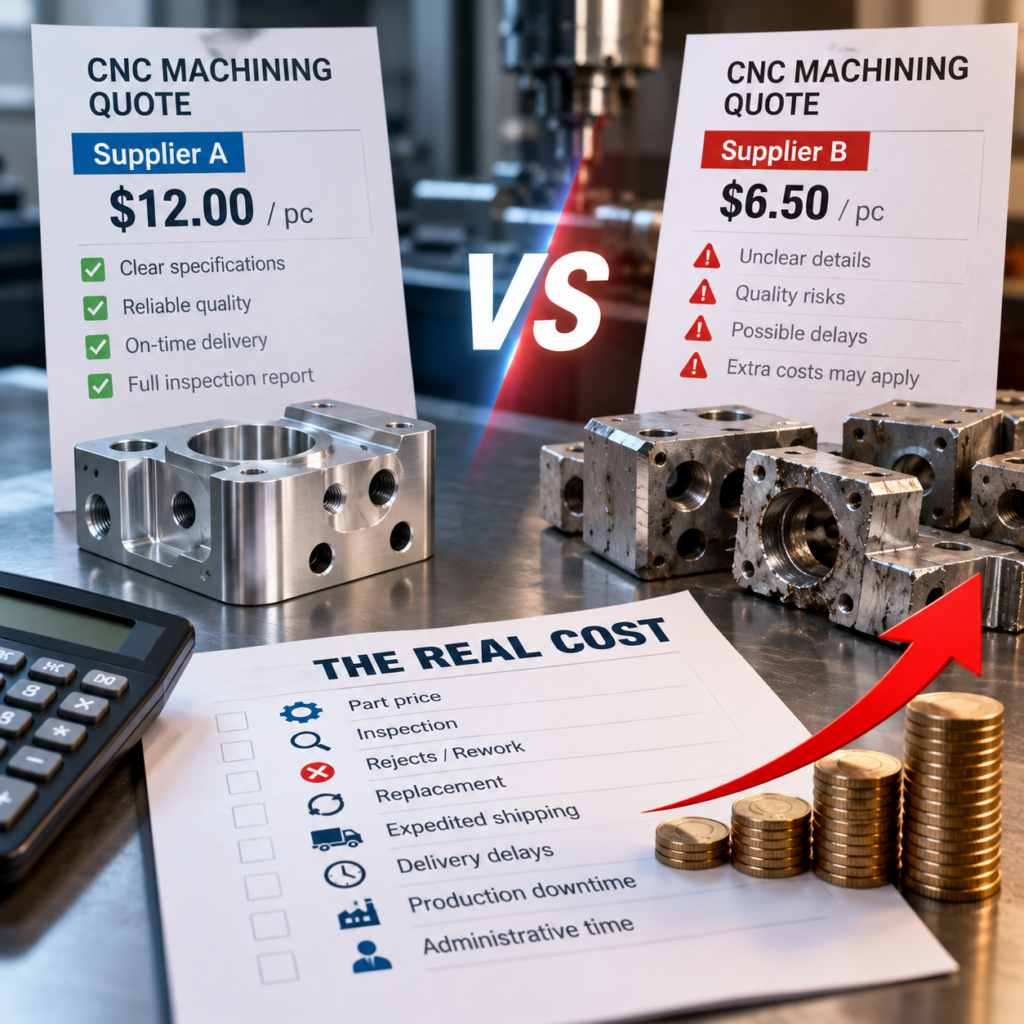
A low unit price can look like a win until rejected parts, missed tolerances, schedule slips, and rework turn it into a costly procurement problem. This page helps buyers compare a CNC machining quote beyond the headline number, so the chosen supplier supports the part, the timeline, and the real budget. Use it to pressure-test a cheap offer before it becomes an expensive order.
According to the American Society for Quality (ASQ), quality-related costs include prevention, appraisal, and internal and external failure costs. When comparing CNC machining quotations, buyers should consider not only the unit price but also the potential costs of inspection, rework, rejected parts, and quality failures.
Is the cheapest CNC machining quote really the lowest cost?
Not always. The cheapest CNC machining quote may only be cheapest at the unit-price level, while the total CNC machining cost includes material, setup, inspection, shipping, communication time, rejected parts, production delays, and the cost of fixing mistakes. A quote that saves a small amount per part can become more expensive if it creates scrap, late assemblies, emergency reorders, or engineering time spent clarifying issues that should have been resolved before production.
Think of unit price as one line in a wider cost picture. Total cost is what your business pays to receive usable parts, on time, with the right documentation and no avoidable disruption to the next step in production. A strong CNC machining quote comparison should therefore ask: What is included, what is assumed, and what happens if the parts do not meet requirements?
Unit price is only one part of CNC machining cost
A low unit price may come from a legitimate efficiency: available machine capacity, optimized programming, material already in stock, or a supplier with the right equipment for the part. It can also come from risky assumptions. If a machinist quotes without reviewing critical tolerances, surface finish needs, inspection requirements, or material availability, the number may be attractive because it is incomplete.
The difference shows up after the purchase order is placed. A buyer may discover that the quote excludes inspection reports, special packaging, deburring, certificates, revision control, or secondary operations. In other cases, the supplier may accept the job at a low price but stretch the delivery date, substitute processes, or ask for changes once production begins. None of these issues appear in a simple unit-price comparison, but each can affect the final cost of usable parts.
Why CNC machining quote vary so much
CNC machining quotations vary because each supplier prices a different combination of material, machine time, setup effort, risk, quality control, and overhead. Two shops can look at the same drawing and arrive at different numbers because they are not always quoting the same production plan.
Key quote drivers include:
- Material choice and availability: Aluminum, stainless steel, titanium, brass, and plastics machine differently and carry different raw material costs. Lead time can also change if the exact grade or size is not readily available.
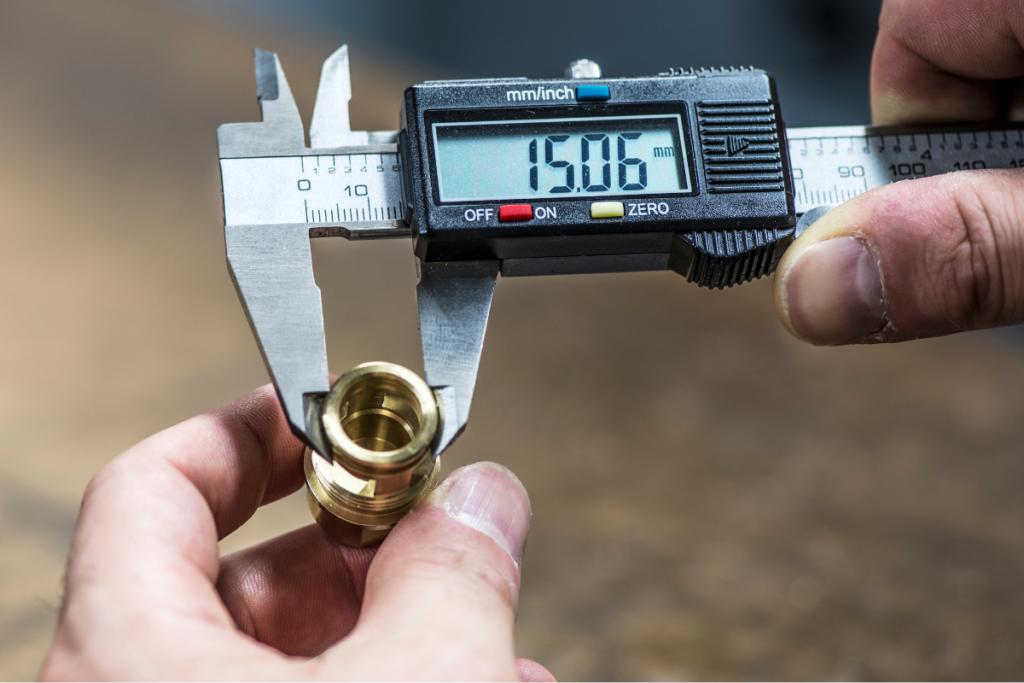
- Tolerances and geometry: Tight tolerances, thin walls, deep pockets, and complex features often require slower machining, extra setups, specialized tooling, or more inspection.
- Machining time: Cycle time, tool changes, programming, fixturing, and number of setups all affect the price. A part that looks simple on a screen may be slow to machine if access is difficult.
- Finishing and secondary work: Anodizing, plating, heat treatment, grinding, bead blasting, passivation, engraving, and deburring can add cost and lead time.
- Inspection requirements: First article inspection, material certificates, dimensional reports, and traceability increase confidence but also require labor and documentation.
- Supplier overhead and capacity: Shops with different equipment, staffing, quality systems, and workload levels may price the same job differently.
A useful CNC machining quote should make these assumptions visible. If a quote is vague, the buyer is left to guess whether the supplier understood the part or simply priced the most optimistic version of it.
Rejected parts create costs that never appear on the quote
Rejected CNC parts are expensive because the loss is not limited to the machined component. Material waste is the obvious cost, especially when the stock is expensive or difficult to source. Rework adds more machine time, inspection time, and handling, and sometimes the part cannot be corrected at all.
The hidden costs are often more damaging. Rejected parts can delay assembly, force engineers to troubleshoot avoidable issues, create urgent replacement orders, and interrupt production planning. If the part is needed for a prototype review, customer shipment, equipment repair, or product launch, the missed milestone may cost more than the original machining order.
This is where the lowest unit price becomes misleading. A slightly higher quote from a supplier that clarifies drawings, confirms tolerances, flags manufacturability concerns, and documents inspection may reduce the risk of receiving unusable parts. Paying for competence before production is usually less painful than paying for correction afterward.
Tolerance assumptions can turn a cheap quote into an expensive order
Tolerance misunderstanding is one of the fastest ways for CNC machining cost to rise after the fact. Tight tolerances require controlled processes, careful fixturing, stable materials, suitable tooling, and more inspection. If a supplier quotes as though general tolerances apply but the part actually contains critical dimensions, the initial price may be too low for the real requirement.
The opposite problem also happens. Buyers sometimes apply tight tolerances to every dimension when only a few features are functionally critical. That can increase CNC machining cost unnecessarily because the machinist must treat the whole part as high precision. A better approach is to identify which features control fit, alignment, sealing, motion, or safety, then allow standard tolerances where precision does not affect performance.
Before accepting a low quote, check whether the supplier has confirmed:
- Which tolerances are critical and which are general.
- How the part will be inspected and documented.
- Whether the chosen material and geometry can hold the required dimensions.
- Whether finishing processes may change final dimensions.
- What happens if a dimension is borderline or out of specification.
This conversation may take a little time, but it prevents the expensive surprise of discovering that the quoted process cannot reliably produce the required part.
Delivery delays affect more than the shipping date
Late CNC parts can create downtime, rescheduling, and rushed decisions. If parts arrive after the assembly window closes, teams may need to move labor, delay testing, postpone customer commitments, or pay for expedited shipping and emergency machining elsewhere. The cost of delay is rarely shown in the original CNC machining quote, but it can quickly outweigh the unit-price savings.
A low quote should be evaluated against the supplier’s ability to meet the promised timeline. Ask whether material is available, whether outside finishing is required, and whether the delivery date is based on current capacity or a best-case estimate. Reliable communication around schedule risk is part of the value you are buying.
Poor communication creates hidden procurement work
When communication is weak, procurement teams become the project managers of preventable confusion. Missing drawing revisions, unclear surface finish notes, unanswered tolerance questions, and assumptions about packaging can lead to wrong parts, rework, and repeated clarification loops. Even when the supplier eventually delivers acceptable parts, the buyer may have spent hours chasing updates, resolving discrepancies, and explaining delays internally.
Strong communication reduces invisible cost. A dependable supplier should acknowledge open questions, confirm revisions, document assumptions, and raise manufacturability concerns before cutting metal. For repeat work, this also protects consistency from order to order.
Red flags before accepting a cheapest CNC machining quote
Be cautious when a quote is far below the others without a clear reason. A low price is not automatically a problem, but it deserves closer review when important details are missing.
Watch for these warning signs:
- The quote does not mention material grade, finish, tolerances, inspection, or revision level.
- The supplier does not ask questions about ambiguous drawings or critical features.
- Lead time sounds aggressive despite special material, finishing, or complex geometry.
- Quality documentation is excluded or unclear.
- Communication is slow before the order is placed.
- The quote compares only unit price and not total delivered cost.
A good CNC machining quote comparison should rank suppliers by usable value, not just by the lowest number.
Compare CNC quotes with total cost in mind
Before you place the order, review the full scope: part requirements, tolerance strategy, inspection needs, delivery risk, communication quality, and what is included in the price. If the low quote still makes sense after that review, it may be the right choice. If not, the safer decision may be the supplier who helps prevent scrap, delay, and rework.
Comparing CNC machining quotations?
Send us your drawings and requirements. We’ll review the material, tolerances, machining processes and secondary operations involved and provide a practical quotation based on the complete manufacturing requirement.