
Choosing between HDPE and UHMW comes down to how the part will be used inside the equipment. Both are common food processing machinery materials because they are lightweight, corrosion resistant, and available in food grade plastic formulations. The practical difference is simple: HDPE is often a cost-effective choice for general wear parts, while UHMW is usually selected when sliding, abrasion, or impact resistance matters more.
HDPE vs UHMW: What is the difference?
HDPE, or high-density polyethylene, is a durable thermoplastic known for its toughness, chemical resistance, and low moisture absorption. It is easy to machine, relatively economical, and widely used for cutting boards, guides, liners, spacers, and other components that need dependable performance without unnecessary complexity.
UHMW, or ultra-high molecular weight polyethylene, is also a polyethylene material, but it has much longer molecular chains. That structure gives it exceptional wear resistance, a very low coefficient of friction, and strong impact performance. In everyday terms, UHMW is the more slippery, abrasion-resistant option; HDPE is the versatile, budget-friendly workhorse.
This is the core of HDPE vs UHMW: they are related plastics, but they are not interchangeable in every application. If a part mostly needs stiffness, sanitation-friendly surfaces, and moderate durability, HDPE may be enough. If it must survive constant product flow, chain contact, conveyor movement, or abrasive ingredients, UHMW often earns its place.
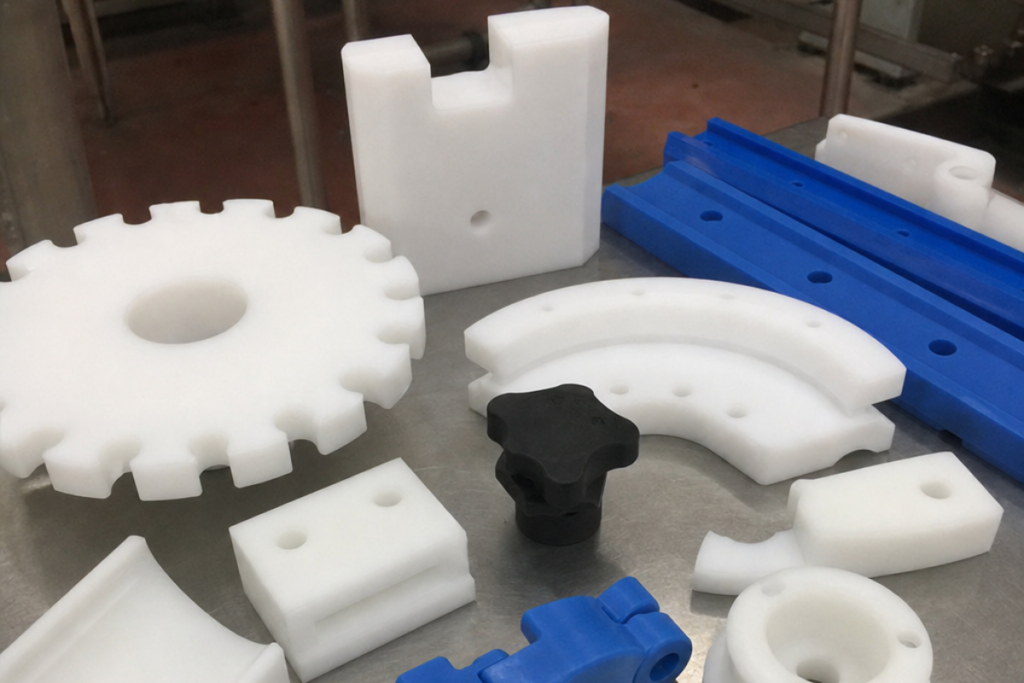
Why both materials are used in food processing equipment
Food processors rely on materials that can handle cleaning routines, moisture, repeated contact, and movement without corroding like untreated metals. HDPE and UHMW are useful because they can be specified in food grade versions, machined into custom shapes, and installed in areas where metal-on-metal contact would create noise, wear, or product handling problems.
Common advantages include:
- Corrosion resistance: Unlike many metals, these plastics do not rust, making them useful around water, washdowns, and moist ingredients.
- Low moisture absorption: They maintain dimensional stability better than materials that swell or degrade when exposed to water.
- Gentle product contact: Plastic guides, rails, and wear strips can reduce scratching, bruising, or marking on packaging and food products.
- Reduced friction: Especially with UHMW, components can help products, belts, chains, or containers move more smoothly.
- Machinability: Both materials can be CNC machined into custom profiles, slots, holes, pockets, and replacement parts.
- Weight savings: Plastic parts can reduce equipment weight compared with many metal alternatives.
For many facilities, the choice is not whether to use plastic at all. It is which food grade plastic best fits the operating conditions.
HDPE is a practical choice for general-purpose parts
HDPE performs well when the application calls for a stable, cleanable, non-corrosive component without extreme sliding wear. It is often chosen for cutting surfaces, guards, fixtures, chute liners, machine panels, star wheels, and simple guide components. Because it is easy to fabricate and machine, HDPE can be a sensible option for prototypes, replacement parts, and components that may need periodic changeout.
The main benefit is balance. HDPE offers good toughness and chemical resistance at a typically lower material cost than UHMW. It can be specified in colors, thicknesses, and sheet sizes that suit many production environments.
However, HDPE has limits. In high-abrasion areas, parts may wear faster than UHMW. In applications with continuous sliding contact, HDPE may create more drag or require more frequent inspection. If the part is under load, near heat, or held to tight tolerances, the design should account for plastic movement and thermal expansion.
UHMW is built for sliding, wear, and impact
UHMW is commonly used where components must move against belts, chains, containers, or product streams. Typical uses include conveyor wear strips, chain guides, timing screw components, guide rails, chute liners, sprockets, rollers, and impact pads. Its low friction can support smoother motion, while its abrasion resistance can extend service life in demanding wear zones.
This does not automatically make UHMW the best choice for everything. UHMW can be more challenging to machine cleanly, and it may be less dimensionally rigid than some alternatives. It is also often selected for performance reasons, so using it where HDPE would work may add unnecessary cost.
A good rule of thumb: choose UHMW when the part’s job involves rubbing, sliding, scraping, or impact. Choose HDPE when the part’s job is mainly support, separation, guarding, or moderate contact.
HDPE vs UHMW food processing equipment comparison
| Consideration | HDPE | UHMW |
|---|---|---|
| Best fit | General-purpose machined parts, cutting surfaces, guards, fixtures | Wear strips, chain guides, rails, liners, high-friction contact points |
| Wear resistance | Good for moderate use | Excellent for abrasive or sliding conditions |
| Friction | Low | Very low |
| Impact resistance | Good | Excellent |
| Machining behavior | Easier to machine and finish | Machinable, but more prone to movement and stringy chips |
| Cost position | Often more economical | Often higher cost, justified by wear performance |
| Main limitation | May wear faster in severe contact areas | Can be harder to hold tight tolerances or fine details |
What should you consider for CNC machining?
CNC machining HDPE and UHMW requires a different mindset than machining metals. These plastics are softer, more flexible, and more sensitive to heat buildup, so tooling, speeds, fixturing, and tolerances must be planned around material behavior rather than metalworking assumptions.
For HDPE, sharp cutters and proper chip evacuation help prevent melting, burrs, or smeared edges. The material machines cleanly when it is well supported, but thin walls and unsupported sections can deflect. Designers should avoid overly tight tolerances unless the application truly needs them, because plastic parts can expand, contract, and relax after machining.
For UHMW, chip control and fixturing become even more important. UHMW can produce long, stringy chips and may flex during cutting. Clamping should hold the part securely without distorting it, and toolpaths should reduce heat and avoid rubbing. When machining wear strips or long guide rails, shops often need to consider bowing, length changes, and how the part will be mounted after machining.
A practical CNC design checklist includes:
- Specify food grade material when product contact is expected.
- Confirm operating temperature, cleaning chemistry, and load conditions.
- Allow realistic tolerances for plastic movement.
- Add radiused corners where possible to reduce stress points.
- Plan mounting holes or slots to accommodate expansion.
- Match the material to the wear pattern, not just the part shape.
Can HDPE or UHMW replace stainless steel?
HDPE or UHMW can replace stainless steel in some food processing equipment components, but not in every role. They are strong candidates for wear parts, guides, liners, guards, spacers, rollers, and other non-structural or moderate-load components. They are not direct replacements for stainless steel where high strength, high heat resistance, structural support, or strict rigidity is required.
The advantages are meaningful. Plastic parts can reduce friction, lower noise, resist corrosion, protect moving products, and prevent metal-to-metal wear. They can also be faster to machine for certain custom replacement parts.
The limitations are just as important. Stainless steel handles higher temperatures, heavier loads, and more rigid structural requirements. It is also preferred where fire resistance, pressure, sanitation design, or regulatory expectations demand metal construction. In many machines, the best answer is not plastic or stainless steel; it is stainless steel frames and contact-safe plastic wear components working together.
Choosing the right material starts with the application
The best answer to HDPE vs UHMW for food processing equipment: which material should you choose? is based on wear, motion, cleaning, temperature, load, and budget. HDPE is often the right fit for dependable general-purpose components. UHMW is usually the stronger choice for sliding contact, conveyor wear, and abrasive product handling.
Before ordering parts, define what the component must survive every day: the ingredients, the washdown process, the speed of movement, the contact pressure, and the expected replacement interval. When those details are clear, the material decision becomes much easier—and the machined part is far more likely to perform as intended.
For components that come into direct contact with food, manufacturers should also verify that the specific material grade is suitable for its intended food-contact application. The U.S. FDA regulates food-contact substances used in applications including food processing equipment and food preparation surfaces. U.S. Food and Drug Administration
Frequently Asked Questions:
Is UHMW better than HDPE?
Not necessarily. UHMW generally provides better wear and impact performance, while HDPE can be more economical for less demanding applications.
Is HDPE suitable for food processing equipment?
Specific HDPE grades can be suitable for food-contact applications, subject to the grade’s regulatory compliance and intended use.
Is UHMW food grade?
Food-contact-compliant UHMW grades are available, but compliance should be verified for the specific material grade and application.
Which is easier to machine, HDPE or UHMW?
Both can be CNC machined, although their relatively soft nature and thermal behavior require different machining considerations compared with metals.
Need Help Choosing the Right Material for Your Machined Parts?
Choosing between HDPE, UHMW, stainless steel, aluminium, or other engineering materials depends on more than material cost alone. Wear, operating temperature, chemical exposure, dimensional tolerances, and the working environment can all affect the final choice.
Send us your drawing for a quotation or material review.