
Burrs may be small, but in precision manufacturing, they can create significant problems.
These unwanted sharp edges can affect component fit, interfere with assembly, damage seals, create safety hazards and reduce the overall quality of a machined part. This makes choosing the right burr removing techniques an important part of the manufacturing process.
In CNC machining, burr removal should not simply be treated as a final clean-up operation. An effective deburring process considers the material, machining method, part geometry, tolerance and required surface finish.
This guide covers why burrs form, the common types of burrs found on machined components and five practical deburring solutions used in manufacturing.
What Are Burrs?
A burr is unwanted material that remains attached to the edge of a component after a manufacturing operation such as CNC milling, CNC turning, drilling, grinding, sawing or cutting.
Burrs commonly appear where the cutting tool enters or exits the workpiece, around drilled holes and at the intersection of machined features.
Depending on the process and material, a burr may appear as a small sharp edge, thin piece of raised material or a larger rolled edge.
Although burrs can sometimes be difficult to see, they may cause:
- Poor component fit and assembly
- Damage to seals and mating surfaces
- Sharp edges that create handling hazards
- Problems with anodising, plating or coating
- Contamination in hydraulic or fluid systems
- Premature wear of moving components
For precision components, effective burr removal is therefore an important part of maintaining consistent product quality.
Why Do Burrs Form During CNC Machining?
Burrs form when material is pushed, stretched or deformed instead of being completely removed by the cutting tool. Burr formation is a well-recognised challenge in machining, and research(Burrs—Analysis, control and removal) has shown that controlling burr formation can reduce the need for costly secondary deburring operations.
Several factors influence burr formation during CNC machining.
Tool Wear
A worn cutting tool does not cut material as cleanly as a sharp tool. Increased cutting forces can push or tear material at the edge of the workpiece, creating larger burrs.
Incorrect Cutting Parameters
Feeds, speeds, depth of cut and tool geometry all affect burr formation. Incorrect machining parameters may increase material deformation and produce rougher edges.
Material Properties
Different materials behave differently during machining. Aluminium and other ductile materials can deform and create rollover burrs, while harder or more brittle materials may produce smaller but sharper burrs.
Tool Entry and Exit
Burrs frequently appear where drills, end mills or other cutting tools exit the material. Without sufficient support, the remaining material can deform before it is completely cut.
Part Geometry
Cross holes, deep holes, slots, thin walls and intersecting features can make burr formation more difficult to control and may also limit access during deburring.
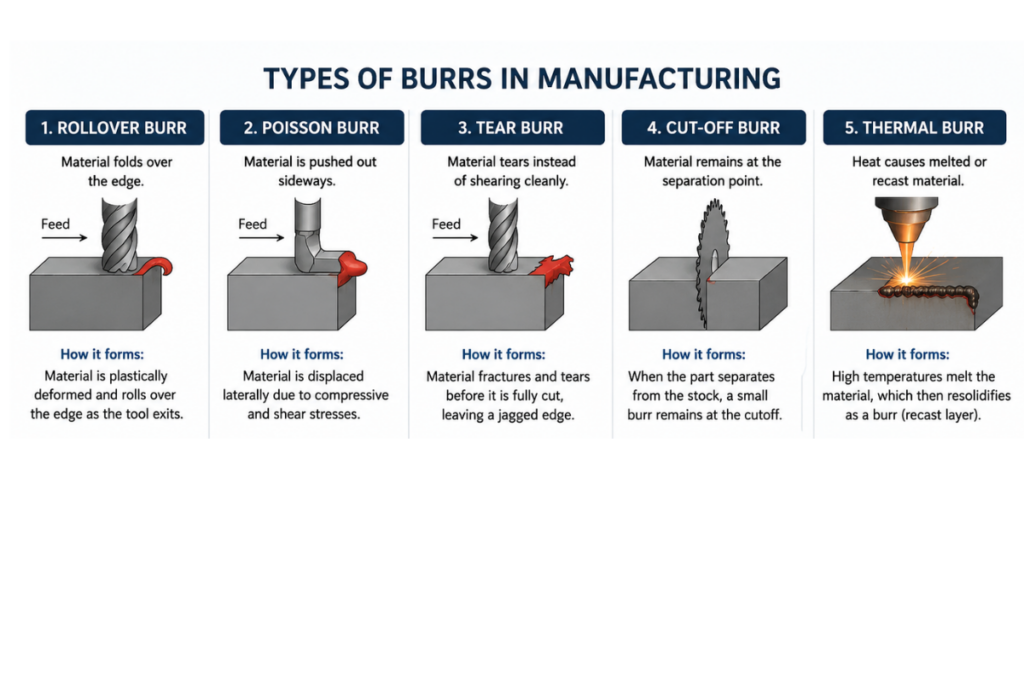
Types of Burrs in Manufacturing
Identifying the type of burr helps manufacturers select suitable burr removing techniques without unnecessarily removing material from the component.
| Burr Type | How It Forms | Common Processes |
| Rollover Burr | Material bends over the edge instead of being completely cut | Milling, turning, drilling |
| Poisson Burr | Material bulges outward under cutting pressure | Turning, milling, shearing |
| Tear Burr | Material tears rather than separating cleanly | Milling, turning |
| Cut-Off Burr | Material remains where a component is separated from stock | Sawing, parting, cutting |
| Thermal Burr | Heat creates melted or recast material along the edge | Laser cutting, EDM, plasma cutting |
Rollover burrs are particularly common in machining because they often occur as the cutting tool exits the workpiece.
5 Effective Burr Removing Techniques
There is no single deburring method suitable for every component. The best solution depends on production volume, material, tolerance, geometry and the location of the burr.
Here are five commonly used deburring solutions for manufactured and CNC-machined parts.
1. Manual Deburring
Manual deburring is one of the simplest and most flexible burr removal methods.
Operators use tools such as:
- Deburring blades
- Files
- Scrapers
- Countersinks
- Abrasive paper or pads
- Small rotary tools
Manual deburring works particularly well for prototypes, small production quantities and components where the operator needs to selectively remove burrs from specific areas.
It also allows difficult features to be inspected and corrected individually.
However, manual deburring depends heavily on operator skill. Excessive pressure can create inconsistent chamfers, scratches or dimensional changes.
Best suited for: prototypes, small batches and accessible external edges.
Read more: Counterbore vs Countersink – What’s the Difference?
2. Rotary and Mechanical Deburring
Rotary deburring uses powered tools fitted with abrasive wheels, carbide cutters, brushes or other finishing tools.
Compared with manual filing, rotary tools can remove burrs faster and provide more consistent results when properly controlled.
Mechanical deburring may also include abrasive belts, grinding wheels and automated brushing systems.
These methods are commonly used for:
- CNC-machined components
- Milled edges
- Drilled holes
- Turned parts
- Larger burrs requiring controlled material removal
Care must be taken around precision dimensions. Aggressive tools can remove more material than required or affect the surrounding surface finish.
Best suited for: low- to medium-volume CNC components and larger accessible burrs.
Read more: CNC Milling Services and CNC Turning Services
3. Abrasive Brushing
Abrasive brushing uses specialised brushes containing abrasive filaments to remove fine burrs and smooth machined edges.
Unlike aggressive grinding, brushing can remove small burrs while producing relatively little change to the component geometry.
It is useful for aluminium, stainless steel, brass and many other machined materials.
Abrasive brushing can also be integrated into automated production processes, improving consistency between components.
For parts with cosmetic requirements, the direction and aggressiveness of brushing should be controlled to avoid unwanted changes to the surface appearance.
Best suited for: fine burrs, machined surfaces and consistent edge finishing.
Read more: Surface Finishing for CNC Machined Parts
4. Vibratory Finishing and Tumbling
For larger quantities of small components, manually deburring every part can become expensive and time-consuming.
Vibratory finishing provides a more efficient deburring solution.
Components are placed into a finishing machine together with abrasive media and finishing compounds. Vibration causes the media to move against the components, gradually removing burrs and smoothing edges.
Barrel tumbling works on a similar principle but uses a rotating barrel.
These methods are particularly useful when many components require similar edge finishing.
However, vibratory finishing is not suitable for every precision component. Parts may contact each other during processing, and excessive finishing time can affect edges or surface appearance.
Best suited for: medium- to high-volume batches of small or robust components.
5. Thermal and Specialised Deburring
Some burrs cannot easily be reached using conventional tools. Cross-drilled holes and internal passages are common examples.
Thermal deburring uses a controlled burst of heat to remove small burrs in areas that mechanical tools cannot easily access.
Other specialised deburring solutions include electrochemical deburring and abrasive flow machining.
These processes are generally considered when components have:
- Complex internal passages
- Intersecting holes
- Difficult-to-access burrs
- High production volumes
- Specific precision requirements
They require specialised equipment and careful process control, so they are normally selected for applications where conventional methods are insufficient.
Best suited for: complex components and inaccessible internal burrs.
How to Choose the Right Deburring Solution
The right method depends on more than the size of the burr.
Manufacturers should consider the material, component geometry, tolerance, production quantity and required surface finish before selecting a process.
| Requirement | Suitable Deburring Solution |
| Prototype or very small quantity | Manual deburring |
| CNC-machined component | Manual or rotary deburring |
| Fine surface burrs | Abrasive brushing |
| Large batch of small components | Vibratory finishing/tumbling |
| Internal or intersecting holes | Specialised/thermal deburring |
| Tight dimensional tolerance | Controlled precision deburring |
The objective is not necessarily to make every edge perfectly smooth. The goal is to achieve the specified edge condition while maintaining dimensional accuracy.
Inspection After Deburring
Deburring should always be followed by inspection.
Depending on the component requirements, inspection may include:
- Visual inspection
- Tactile inspection
- Magnification
- Vernier or micrometer measurement
- Profile projector inspection
- Functional or assembly testing
Critical dimensions should also be checked where the deburring process could remove material close to a tolerance-controlled feature.
For precision CNC machining, burr removal and inspection should therefore be considered part of the overall quality process rather than separate operations.
How to Prevent Burrs During CNC Machining
The most cost-effective deburring solution is often to minimise burr formation before it happens.
Manufacturers can reduce burrs by:
- Replacing worn cutting tools
- Optimising feeds and speeds
- Selecting suitable tool geometry
- Improving workholding and machine rigidity
- Controlling tool entry and exit
- Using appropriate coolant
- Adding chamfers or radii where the design allows
- Planning machining sequences to minimise difficult exit burrs
Good process planning can reduce secondary deburring time, improve consistency and lower overall production costs.
Frequently Asked Questions
What is the best technique for removing burrs?
There is no single best technique. Manual deburring is suitable for prototypes and small batches, while vibratory finishing may be more economical for larger quantities. Complex internal burrs may require specialised processes.
Why is deburring important in CNC machining?
Deburring removes sharp or unwanted material that can affect assembly, dimensional accuracy, safety, sealing surfaces and component performance.
How do you remove burrs from aluminium?
Small aluminium burrs can often be removed using deburring blades, rotary tools, abrasive brushes or vibratory finishing. The method should be controlled because aluminium is relatively soft and excessive deburring can affect dimensions or cosmetic surfaces.
Can deburring affect part tolerances?
Yes. Aggressive deburring can remove material from critical edges or features. For precision components, the deburring process should be selected according to the drawing tolerance and required edge condition.
Can burr formation be prevented completely?
Not always, but it can often be significantly reduced through proper cutting tools, machining parameters, toolpaths, fixturing and part design.
Conclusion: Better Deburring Starts with Better Machining
Selecting the right burr removing techniques helps manufacturers improve component quality, assembly, safety and consistency.
From simple manual tools to automated and specialised deburring solutions, the appropriate method depends on the material, geometry, production quantity and tolerance of the component.
More importantly, effective burr control starts during the CNC machining process itself. Proper tooling, cutting parameters, machining strategy and inspection can minimise burr formation and reduce unnecessary secondary processing.
Looking for a CNC Machining Partner in Malaysia?
SwisHomestech (M) Sdn Bhd provides precision CNC machining services for prototypes, small batches and production components across a wide range of materials.
From machining and deburring to inspection and surface finishing, we work with customers to manufacture components according to drawing specifications and quality requirements.
Have a part you need manufactured? Send us your drawing or RFQ to discuss your CNC machining requirements.