
When designing machined components, even the smallest hole feature can affect assembly, strength, appearance, and manufacturing cost. Choosing between a counterbore and a countersink may seem like a minor detail, but selecting the wrong one can lead to poor fastener seating, assembly issues, or unnecessary machining operations.
In CNC machining and CNC milling, counterbores and countersinks are two of the most common hole features used to accommodate screws and bolts. Although they serve a similar purpose, they are designed for different fastener types and applications.
In this guide, we’ll explain the difference between counterbore vs countersink, when to use each feature, how they are machined, and what designers should consider when working with steel, aluminium, and other engineering materials.
What Is a Counterbore?
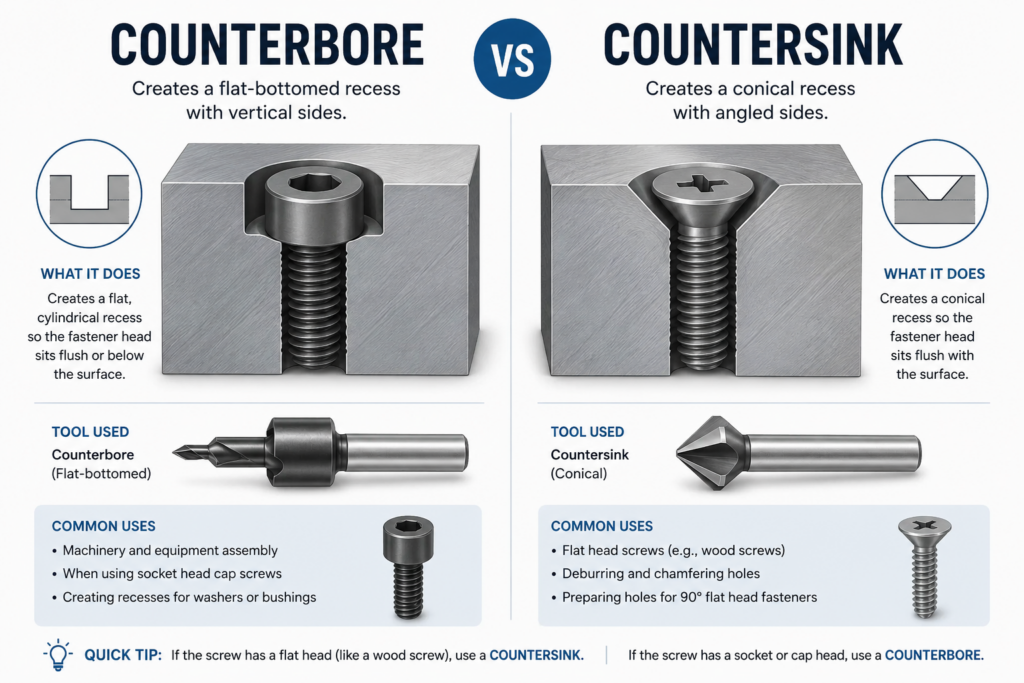
A counterbore is a cylindrical, flat-bottomed recess machined into the top of a drilled hole. Its purpose is to allow the head of a bolt or socket head cap screw to sit flush with or below the surface of the workpiece.
Instead of leaving the fastener protruding above the surface, the counterbore creates a precise pocket that provides a flat seating surface for the screw head.
Counterbores are commonly used with:
- Socket head cap screws
- Hex head bolts
- Shoulder bolts
- Machine screws with flat bearing surfaces
- Fasteners requiring high clamping force
Because the bottom of a counterbore is flat, it distributes clamping force evenly, making it ideal for structural and precision mechanical assemblies.
In CNC machining, counterbores are typically produced using end mills, dedicated counterbore cutters, or circular interpolation on CNC machining centres.
What Is a Countersink?
A countersink is a conical recess machined at the opening of a drilled hole. It is designed to match the angled underside of a flat-head screw so the screw sits flush with the surface.
Unlike a counterbore, a countersink does not create a flat-bottom pocket. Instead, it produces an angled seating surface that allows the screw head to become part of the finished surface.
Countersinks are commonly used with:
- Flat head screws
- Countersunk machine screws
- Wood screws
- Decorative fasteners
- Components requiring a smooth surface finish
Typical countersink angles include 82°, 90°, and 100°, depending on the fastener standard being used. Matching the screw angle to the countersink angle is essential to ensure proper seating and load distribution.
In CNC milling, countersinks are usually machined using countersink cutters, chamfer mills, or spot drills.
Counterbore vs Countersink: What’s the Difference?
Although both features enlarge the opening of a drilled hole, they serve different purposes.
| Feature | Counterbore | Countersink |
|---|---|---|
| Shape | Cylindrical | Conical |
| Bottom | Flat | Angled |
| Fastener Type | Socket head cap screw, bolt | Flat head screw |
| Surface Finish | Screw sits below or flush | Screw sits flush |
| Clamping Surface | Flat bearing surface | Tapered seating surface |
| CNC Tool | End mill or counterbore cutter | Countersink cutter or chamfer mill |
| Typical Applications | Machine parts, fixtures, tooling | Covers, panels, enclosures |
Neither feature is “better” than the other. The correct choice depends on the fastener, application, material thickness and functional requirements of the component.
When Should You Use a Counterbore?
A counterbore is generally preferred when strength and secure clamping are the priority.
Typical applications include:
- Machine bases
- Precision fixtures
- Tooling plates
- Hydraulic manifolds
- Robotic equipment
- Industrial machinery
- Structural assemblies
Choose a counterbore when:
- Using socket head cap screws
- High clamping force is required
- The screw head should be recessed below the surface
- A flat seating surface is necessary
- The component will be assembled and disassembled repeatedly
Counterbores are especially common in steel CNC machined parts, where strong, repeatable fastening is required.
When Should You Use a Countersink?
A countersink is ideal when appearance and surface clearance are more important than maximum clamping area.
Common applications include:
- Aluminium panels
- Machine covers
- Electronic enclosures
- Consumer products
- Furniture components
- Decorative assemblies
Choose a countersink when:
- The fastener has a tapered head
- A flush surface is required
- Limited clearance exists above the component
- The finished part will be visible
- Protruding screw heads must be avoided
Countersunk screws are frequently used in aluminium CNC machined parts because they provide a clean, professional appearance while maintaining a low-profile assembly.
How Counterbores and Countersinks Are Machined in CNC Milling
Modern CNC milling machines produce counterbores and countersinks with exceptional accuracy and repeatability.
Machining a Counterbore
A typical machining sequence includes:
- Spot drilling
- Drilling the through hole
- Machining the counterbore using:
- Counterbore cutter
- End mill
- Circular interpolation
Depth is carefully controlled to ensure the fastener sits at the correct height.
Machining a Countersink
The process generally involves:
- Drilling the hole
- Using a countersink cutter or chamfer mill
- Machining the specified angle
- Verifying screw fit and flushness
Modern CNC machining ensures consistent hole geometry across prototypes and production batches.
Common Design Mistakes to Avoid
Although counterbores and countersinks are simple features, incorrect design can lead to assembly problems.
Common mistakes include:
- Using a countersink with a socket head cap screw
- Using a counterbore for a flat head screw
- Selecting the wrong countersink angle
- Machining the counterbore too deep
- Leaving insufficient material around the hole
- Ignoring burr removal after machining
- Designing features that cannot be reached by standard cutting tools
Reviewing fastener specifications during the design stage helps avoid unnecessary machining costs and rework.
Frequently Asked Questions
Is a counterbore stronger than a countersink?
Generally, yes. A counterbore provides a flat bearing surface that distributes clamping force more evenly, making it suitable for higher-load applications.
Can CNC milling produce both counterbores and countersinks?
Yes. Modern CNC milling machines can machine both features accurately using dedicated tooling or interpolation techniques.
Which is better for aluminium?
Neither is inherently better. Counterbores are preferred for high-strength mechanical joints, while countersinks are commonly used where a flush, clean appearance is required.
What happens if the countersink angle is incorrect?
An incorrect angle prevents the screw head from seating properly, leading to uneven contact, poor alignment and reduced clamping performance.
Final Thoughts
Understanding the difference between counterbore and countersink is essential for designing reliable and cost-effective machined components. While both features prepare holes for fasteners, they are intended for different screw types and engineering requirements.
Counterbores provide a flat-bottomed recess that supports socket head screws and high clamping loads. Countersinks create a conical seat that allows flat head screws to sit flush with the surface, improving appearance and clearance.
Whether you’re machining steel, aluminium, or other engineering materials, selecting the correct hole feature improves assembly quality, machining efficiency and long-term product performance.
At Swisstech, we specialise in precision CNC machining and CNC milling for custom components across industries including food machinery, automation, oil & gas and industrial equipment. From prototype development to production machining, our experienced team can help optimise every design detail—including selecting the right counterbore or countersink for your application.
Contact Swisstech today to discuss your CNC machining requirements.