
When purchasing raw materials for CNC machining, fabrication or construction, appearance alone cannot verify whether the metal meets the required specification. Two pieces of material may look identical, yet have completely different chemical compositions, mechanical properties and performance.
This is where a mill certificate, also known as a Mill Test Report (MTR) or Material Test Certificate (MTC), becomes essential.
A mill certificate provides documented evidence that a batch of material has been manufactured and tested according to recognised industry standards. Whether you’re producing precision CNC machined parts, structural steel components or critical equipment for the oil & gas, food processing or medical industries, verifying the mill certificate helps ensure product quality, material traceability and regulatory compliance.
What is a Mill Certificate?
A mill certificate is an official quality document issued by the steel mill or aluminium manufacturer that records the test results of a specific production batch.
The document confirms that the material supplied complies with the required specification by listing its:
- Material grade
- Chemical composition
- Mechanical properties
- Manufacturing standards
- Heat (batch) number
- Manufacturer information
The terms Mill Certificate, Mill Test Report (MTR) and Material Test Certificate (MTC) are often used interchangeably throughout the manufacturing industry.
Unlike a simple declaration of conformity, an MTR contains actual laboratory test results for the exact batch of material supplied.
Why is a Mill Certificate Important?
For manufacturers and engineers, a mill certificate is far more than paperwork. It provides confidence that the raw material being used is suitable for its intended application.
1. Confirms Material Quality
Before steel or aluminium leaves the mill, samples are tested to verify that they meet recognised standards such as ASTM, EN or JIS. The mill certificate confirms that the material grade ordered is exactly what has been supplied.
For example:
- Aluminium 6061 instead of a lower-grade substitute
- Stainless Steel 316 instead of 304
- S355 structural steel instead of mild steel
Using the wrong material grade can lead to machining issues, corrosion problems or even structural failure.
2. Ensures Material Traceability
Every batch of raw material is assigned a unique Heat Number during production. This number acts as the material’s identity throughout its entire lifecycle. By matching the heat number stamped on the steel or aluminium with the mill certificate, manufacturers can trace the material back to its original production batch.
Material traceability is particularly important for industries such as:
- Aerospace
- Medical devices
- Oil & Gas
- Food processing
- Automotive
- Semiconductor manufacturing
Many ISO 9001 quality management systems also require complete material traceability.
3. Meets Customer and Regulatory Requirements
Many customers require a Mill Test Report before accepting finished parts.
Industries with strict quality requirements often specify standards such as:
- ASTM Material Specifications
- EN 10204 3.1 Certification
- ISO standards
- Customer-specific material requirements
Without proper documentation, parts may fail customer inspection regardless of how accurately they were machined.
4. Reduces Project Risk
Material verification helps prevent costly mistakes. Imagine machining hundreds of precision components only to discover the material supplied was the wrong alloy.
Without a valid mill certificate, manufacturers risk:
- Production delays
- Material rejection
- Product recalls
- Contract disputes
- Safety failures
- Increased manufacturing costs
Verifying the material before machining begins is far less expensive than replacing finished parts.
What Information is Included in a Mill Test Report?
A genuine mill certificate should contain detailed information about the material batch.
| Information | Why It Matters |
|---|---|
| Manufacturer Details | Identifies the producing mill |
| Material Grade | Confirms the alloy supplied |
| Material Dimensions | Verifies the supplied size |
| Heat Number | Enables full material traceability |
| Chemical Composition | Confirms alloy elements meet specification |
| Mechanical Properties | Shows strength, hardness and ductility |
| Manufacturing Standard | ASTM, EN, JIS or other applicable standards |
| Inspection Approval | Official signature or quality control stamp |
Every section contributes to proving that the material complies with the customer’s requirements.
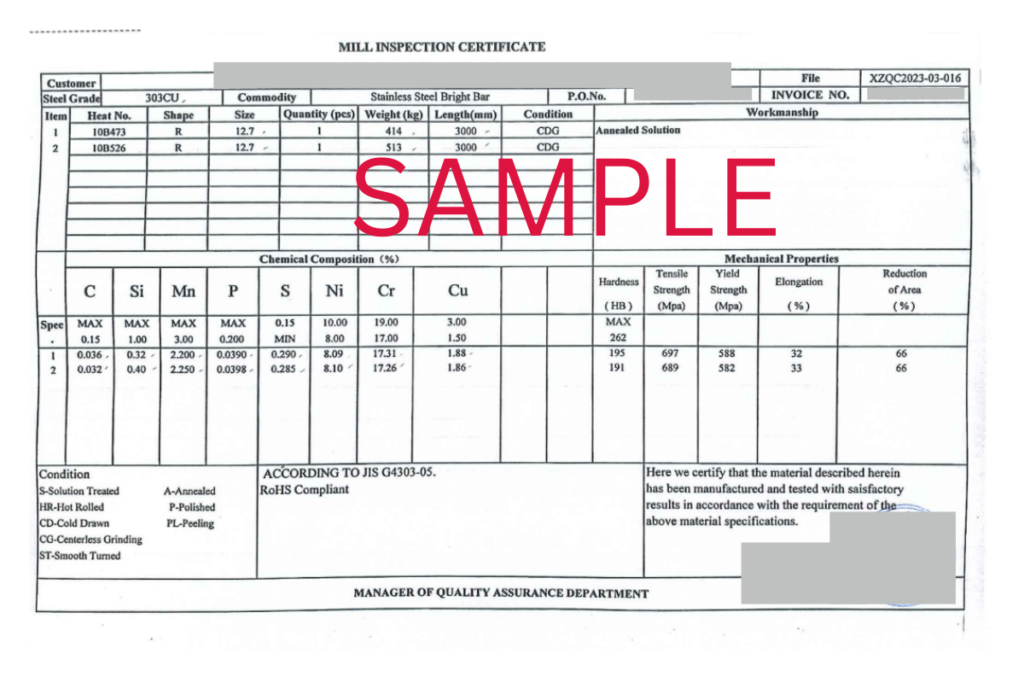
How to Read a Mill Test Report
Although a Mill Test Report may appear technical, reviewing one becomes straightforward once you know what to check.
Step 1: Verify the Material Grade
Start by confirming the material grade matches your purchase order.
Examples include:
- Aluminium 6061
- Aluminium 7075
- Stainless Steel 304
- Stainless Steel 316L
- S355 Steel
- SS400
- Brass
- Bronze
Any discrepancy should be clarified before production begins.
Step 2: Check the Heat Number
The Heat Number is arguably the most important part of the certificate.
Compare the heat number on the certificate with the marking on the raw material.
If the numbers do not match, the certificate cannot verify that specific material.
Step 3: Review the Chemical Composition
The report lists the percentage of alloying elements contained in the material.
For aluminium alloys, this may include:
- Silicon (Si)
- Magnesium (Mg)
- Copper (Cu)
- Iron (Fe)
For steel, common elements include:
- Carbon (C)
- Manganese (Mn)
- Chromium (Cr)
- Nickel (Ni)
- Molybdenum (Mo)
These elements determine the material’s strength, corrosion resistance and machinability.
Step 4: Review Mechanical Properties
Mechanical test results typically include:
- Yield Strength
- Tensile Strength
- Elongation
- Hardness
These values confirm whether the material meets the required engineering specification.
Step 5: Confirm Compliance Standards
Finally, verify the applicable standards listed on the report.
Common examples include:
- ASTM
- EN 10204 3.1
- JIS
- DIN
For European projects, EN 10204 Type 3.1 certification is one of the most commonly requested inspection documents because it provides independent validation of the test results.
Mill Certificate vs Certificate of Conformance (CoC)
These two documents are often confused, but they serve different purposes.
| Mill Test Report (MTR) | Certificate of Conformance (CoC) |
| Contains actual laboratory test results | States the material complies with requirements |
| Batch-specific | Usually applies generally to supplied products |
| Includes heat number | May not include heat number |
| Lists chemical composition | Usually does not |
| Lists mechanical properties | Usually does not |
| Used for traceability | Used for compliance declaration |
For critical applications, customers generally require a Mill Test Report rather than a Certificate of Conformance alone.
Why Mill Certificates Matter in CNC Machining
For CNC machining companies, the quality of the finished component begins with the quality of the raw material.
Even with advanced machining centres and precise programming, using the wrong steel or aluminium grade can result in:
- Poor machinability
- Increased tool wear
- Dimensional instability
- Surface finish issues
- Welding defects
- Inconsistent anodising
- Reduced corrosion resistance
Verifying the mill certificate before production helps ensure the material performs as expected throughout the machining process.
At Swisstech, we verify raw material specifications whenever customer requirements call for certified material traceability. This helps ensure every machined component is produced using the correct material and supported by the appropriate documentation.
Frequently Asked Questions
Is a mill certificate mandatory?
Not always. However, many industries such as aerospace, oil & gas, medical and food processing require mill certificates to verify material quality and traceability.
What is the difference between a Mill Test Report and a Material Test Certificate?
In most industries, the terms Mill Test Report (MTR), Mill Certificate and Material Test Certificate (MTC) refer to the same document.
Can aluminium have a mill certificate?
Yes. Aluminium manufacturers routinely issue mill certificates that confirm alloy grade, chemical composition and mechanical properties.
Conclusion
A mill certificate is one of the most important quality documents in modern manufacturing. It provides documented evidence that steel, aluminium and other engineering materials meet the required chemical composition, mechanical properties and recognised industry standards.
Whether you’re manufacturing precision CNC components, structural assemblies or industrial equipment, verifying the Mill Test Report (MTR) helps reduce quality risks, improve material traceability and ensure compliance with customer requirements.
At Swisstech, we understand that quality starts long before machining begins. By sourcing certified raw materials and supporting customer requirements for material traceability, we help ensure every machined component is manufactured from the correct steel or aluminium grade with confidence. Contact us to discuss your requirements.