
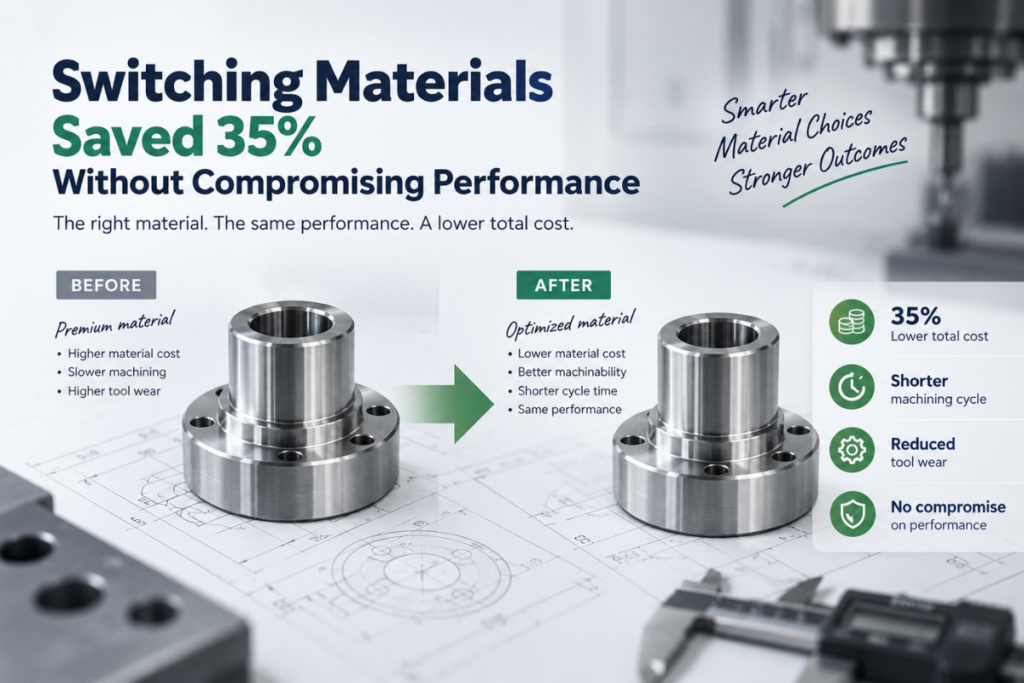
A CNC-machined part can meet every drawing requirement and still cost more than it needs to. In this case study, through material optimization in CNC machining helped reduce costs by 35% without compromising performance. The savings came from questioning an over-specified material choice—not from weakening the design or cutting corners.
The result shows how careful CNC machining material selection can maintain functionality while bringing down cycle time, scrap risk, and reduce CNC machining costs.
How Can Material Optimization in CNC Machining Reduce Cost Without Reducing Performance?
A material change can safely reduce costs when the replacement material still meets the part’s actual operating requirements, rather than simply following assumptions built into the original design.
Many machined parts are specified with a premium alloy because it feels like the safer choice, because it was used in an earlier design, or simply because no one had the opportunity to review the application closely.
Material optimization in CNC machining starts by separating what the part actually needs from what the current material happens to provide.
In this case, the original material performed well, but it offered more capability than the application required. The team reviewed the part’s load, wear exposure, dimensional tolerances, finish requirements, and operating environment. Once those needs were clearly defined, a more machinable and cost-effective material became a practical option.
The Challenge: A Part That Was More Expensive Than It Needed to Be
The part was not failing in use. In fact, that was part of the problem. Because its performance was acceptable, the material choice had never been questioned. Yet the machining process was expensive, and the part consumed more of the customer’s budget than necessary each time it was ordered.
The original material created cost pressure in several ways. It required slower cutting parameters, contributed to higher tool wear, and increased machining time. It also carried a higher raw material cost than the application justified.
None of these issues appeared dramatic on their own, but together they made the finished component unnecessarily expensive.
The goal was not simply to “find a cheaper substitute.” The goal was to reduce CNC machining costs without changing how the part functioned within the assembly. This meant that any proposed material still had to provide the required strength, stability, surface finish, and service life.
The Review Focused on Requirements, Not Assumptions
The first step was to revisit the design intent. Instead of treating the existing material as fixed, the team asked what the part actually had to survive during normal use. That review included practical questions about mechanical demand, operating conditions, and manufacturing behavior.
Key evaluation points included:
- Functional load: The replacement material needed enough strength for the real forces involved, with appropriate design margin.
- Dimensional stability: The part had to hold tolerance during machining and in service.
- Surface finish: The material needed to machine cleanly enough to meet fit and appearance requirements.
- Wear and contact conditions: Areas subject to friction, fastening, or repeated handling had to remain reliable.
- Environmental exposure: Temperature, moisture, chemicals, and corrosion risk had to be considered before approving the change.
- Availability: A material that looks good on paper can still create delays if sourcing is inconsistent.
This type of review prevents material optimization in CNC machining from becoming a guessing exercise. It also gives engineering, purchasing, and manufacturing a shared basis for approval.
Where did the 35% savings come from?
The 35% savings came from the total manufacturing cost of the part—not just the price of the raw material.
The new material was less expensive to purchase, but the larger impact came from improved machinability and a more efficient production process. Faster cutting, reduced tool wear, and more predictable machining behaviour all contributed to reduce CNC machining costs.
Material cost is often the easiest number to see, but it is only one part of the equation.
A material that machines poorly can increase spindle time, require more frequent tool changes, and raise the risk of rework or scrap. In contrast, a material that machines more predictably can improve throughput and help keep production costs under control.
In this case, the selected alternative allowed the part to be produced more efficiently while still meeting the application’s requirements.
The design did not have to be downgraded. The material was simply better matched to the job.
Why Material Optimization In CNC Machining Should Happen Early
CNC machining material selection has the biggest impact when it happens before a design is locked. At that stage, engineers and manufacturers can discuss performance needs, tolerance demands, finishing expectations, and production volume together. That conversation often reveals lower-cost options that would be difficult to introduce later.
Early material review also helps avoid hidden costs. Some materials are strong but abrasive. Some are corrosion-resistant but slow to machine. Others are easy to cut but may not suit tight tolerances, heat exposure, or cosmetic requirements. The right choice depends on the complete manufacturing and operating requirements of the component. Resources such as the ASM Handbook on Materials Selection and Design also emphasize the relationship between material properties, manufacturing processes, design requirements, and performance when evaluating material choices.
A practical material selection process should consider:
- What the part must do: Define load, fit, wear, environment, and expected life.
- What the drawing requires: Check tolerances, finish callouts, threads, wall thicknesses, and critical features.
- How the material machines: Review cycle time, tool wear, chip control, and workholding behavior.
- How the material is sourced: Consider lead time, stock sizes, minimum order quantities, and consistency.
- How the change will be validated: Confirm inspection results and functional performance before full production.
This approach keeps cost reduction grounded in evidence instead of preference.
The Validation Step Protected Performance
A material switch should never move straight from suggestion to full production. Before the change was accepted, the part had to be machined, inspected, and reviewed against the original performance requirements. That validation step is what made the savings credible.
The review confirmed that the revised material could meet the dimensional and functional needs of the part. Machining behavior improved, and the finished component continued to satisfy the application. Because the team checked the change against defined requirements, the decision was controlled rather than risky.
For many companies, this is the most important lesson. To reduce CNC machining costs does not require accepting uncertainty. It requires a structured review, a clear approval process, and the discipline to test assumptions before scaling production.
Practical Takeaways for Your Next Machined Part
This case study highlights a common opportunity: the material specified on a drawing may not be the most economical material for the job. If a part is expensive, difficult to machine, or repeatedly quoted higher than expected, the material is worth reviewing.
Use this checklist before assuming the current specification is final:
- Is the material required by the application, or was it carried over from an older design?
- Are the strength, hardness, or corrosion properties higher than the part actually needs?
- Does the material increase cycle time or tool wear?
- Are there more machinable alternatives that meet the same functional requirements?
- Can the change be tested with a small production run before full release?
- Have engineering, quality, and manufacturing all reviewed the risks and benefits?
The best results usually come from collaboration. Engineers understand the design intent. Machinists understand what happens at the spindle. Purchasing understands availability and cost pressure. When those perspectives come together, material optimization becomes a practical path to savings.
A Smarter Material Can Be a Stronger Business Decision
Switching materials is not about choosing the lowest-priced option. It is about choosing the most appropriate option for the part’s purpose, production method, and long-term value. In this case, that decision reduced cost by 35% without compromising performance.
For teams managing tight budgets, recurring machined components, or rising supplier quotes, reviewing material choice can be one of the most effective next steps. A structured approach to CNC machining material selection may reveal savings already built into the design, waiting to be unlocked.
Could Your Machined Parts Be Over-Specified?
If you’re facing rising machining costs, long production cycles, or expensive material requirements, it may be worth taking another look at the original specification.
At Swisstech, we work with customers to review material choices, machining requirements, tolerances, and production methods to identify practical cost-saving opportunities—without compromising the required function or quality of the finished part.
Have an existing drawing you’d like us to review? Contact us to discuss your CNC machining requirements or request a quotation.