
Laser cutting vs CNC milling, which one should you choose? They solve different production problems. In most cases, laser cutting is the better fit for fast, flat sheet material cutting, while CNC milling is the better fit for machined parts with depth, pockets, contours, threads, and tight three-dimensional features. This comparison explains how each process works, where costs come from, and how to choose the right method for your part.
Laser Cutting vs CNC Milling, Which process is better for your part?
Laser cutting is usually better when the part is made from sheet material and the geometry is mostly 2D parts. CNC milling is usually better when the part needs material removed at different depths or requires features that cannot be created by cutting a flat profile alone. If your part looks like a bracket, panel, shim, enclosure blank, or flat profile, start by considering laser cutting. If it looks like a housing, fixture, mold component, precision block, or mechanical part with holes, slots, shoulders, or surfaces at multiple levels, start with CNC milling.
A practical way to decide is to ask what the process must physically do. Laser cutting separates material along a programmed path using a focused beam, so it excels at cutting outlines and internal shapes in sheet. CNC machining with a milling tool removes material mechanically, which makes it more flexible for shaping solid stock, refining surfaces, and creating complex features.
How the processes work
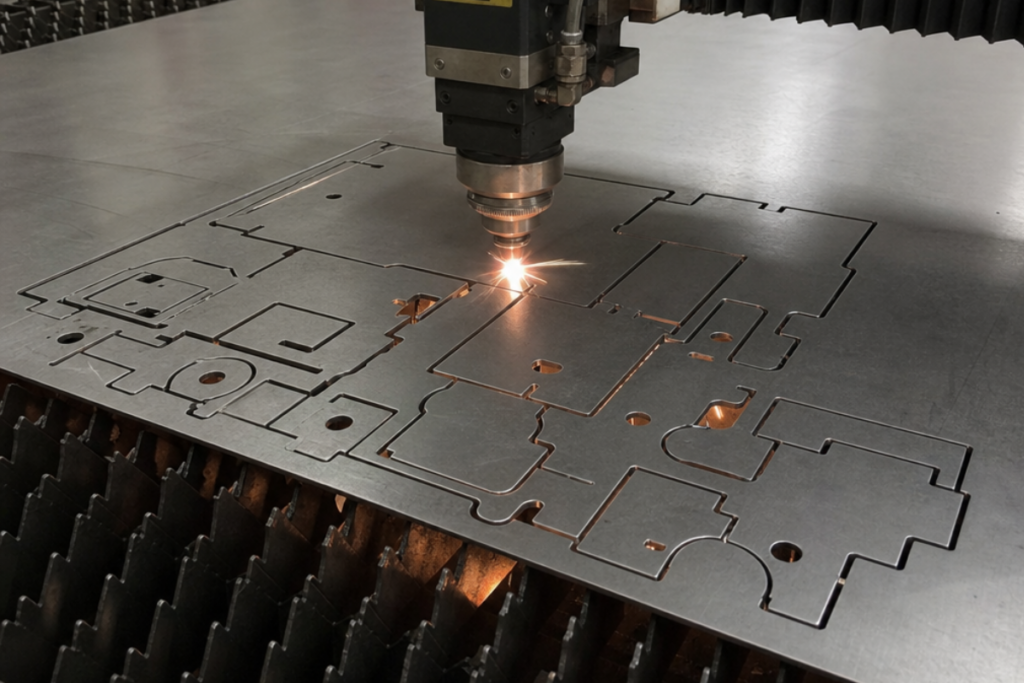
Laser cutting is a thermal cutting process that uses a focused laser beam to cut through materials such as metals and plastics. The machine follows a digital cutting path, often assisted by gas, to create clean profiles, slots, holes, and patterns. Because there is no rotating cutting tool pressing into the workpiece, laser cutting can move quickly across flat material and produce intricate shapes with relatively low setup time. For a more detailed explanation of the process and its industrial applications, refer to TWI’s guide to laser cutting.
CNC milling uses computer-controlled rotating cutters to remove material from a workpiece. The machine can cut along multiple axes, step down into the part, create pockets, flatten surfaces, drill holes, and machine features to specific depths. CNC milling is slower for simple 2D perimeter cutting, but it can produce shapes and functional details that laser cutting cannot create on its own.
The biggest difference is dimensional capability. Laser cutting is mainly a profile-cutting process for sheet and plate. CNC milling is a subtractive CNC machining process for both flat and block-like parts where depth, surface geometry, and feature relationships matter.
Laser Cutting vs CNC Milling: comparison by decision criteria
| Factor | Laser Cutting | CNC Milling |
|---|---|---|
| Best for | 2D parts | Precision/3D parts |
| Geometry | Mainly flat profiles | Pockets, holes, slots, contours |
| Speed | Very fast for sheet parts | Generally slower |
| Setup cost | Lower | Higher |
| Tight tolerances | Moderate | Excellent |
| Surface finish | Cut edge may need finishing | Controlled machined finish |
| Heat affected zone | Yes | No thermal cutting |
| Threads | No | Yes |
| Chamfers | Limited/secondary process | Easily machined |
| Depth features | No | Yes |
| Cost | Lower for simple profiles | Higher, but more capability |
Which process is cheaper?
Laser cutting is usually cheaper for flat 2D parts made from sheet material, especially when many pieces can be nested efficiently on the same sheet. It often has lower setup effort for profile cutting, faster cutting paths for simple shapes, and less need for custom workholding. For brackets, panels, flat blanks, signs, guards, and many enclosure components, laser cutting is commonly the more economical starting point.
CNC milling becomes cheaper, or at least more cost-effective, when the alternative would require laser cutting plus multiple secondary operations. If a part needs accurate pockets, milled slots, tapped holes, stepped surfaces, or tight relationships between features, CNC milling may avoid extra handling and rework. It can also be the better value for thicker solid parts where a laser is not appropriate or where the required geometry is not possible with a 2D cut.
The lowest quoted process is not always the lowest total cost. A laser-cut blank that still needs extensive machining, deburring, forming, or finishing may end up costing more than a planned CNC milling operation. Likewise, milling a simple flat profile from solid stock can waste time and material compared with cutting it directly from sheet.
Cost factors that influence the final price
Several variables affect whether laser cutting vs CNC milling is more economical for a specific job. These factors also explain why two similar-looking parts can have very different manufacturing costs.
Laser cutting cost factors
- Material type and thickness, because thicker or harder material can slow cutting and affect edge quality.
- Sheet utilization, because better nesting reduces scrap and spreads material cost across more parts.
- Cut length and complexity, since many small holes or intricate contours can increase machine time.
- Pierces and internal features, because each new cut start may add time.
- Secondary operations such as deburring, bending, tapping, welding, or finishing.
CNC milling cost factors
- Raw stock size, because milling from oversized material can increase waste and machining time.
- Number of setups, since repositioning the part adds labor and risk.
- Feature complexity, including pockets, contours, tight corners, deep cavities, and fine details.
- Tooling requirements, because different cutters may be needed for roughing, finishing, drilling, and threading.
- Tolerance and finish expectations, which can require slower passes or additional inspection.
Application examples
Laser cutting is a strong choice for sheet-based parts that need accurate profiles without complex depth features. Common examples include electrical panels, flat brackets, machine guards, decorative metal screens, gaskets, shims, nameplates, enclosure blanks, and prototypes cut from sheet. It is also useful when many part shapes can be arranged on one sheet to reduce waste.
CNC milling is a strong choice for parts that must perform mechanically and fit precisely with other components. Examples include fixtures, tooling plates, machine components, housings, mounting blocks, mold inserts, prototypes from solid material, and parts with pockets or threaded holes. CNC milling is also preferred when a surface must be machined flat or when features must align accurately across multiple faces.
Some projects use both processes together. A manufacturer may laser cut a rough blank from sheet or plate, then use CNC milling to add precision holes, countersinks, slots, or mating surfaces. This hybrid approach can reduce material removal while still achieving the functional accuracy of CNC machining.
Frequently Asked Questions
1. Can Aluminium Be Laser Cut?
Yes, aluminium can be laser cut. Modern fiber laser cutting machines can efficiently cut aluminium sheet material and plates across a range of thicknesses.
However, aluminium is highly reflective and conducts heat quickly, which can make it more challenging to laser cut than materials such as mild steel. The achievable cut quality and thickness depend on factors such as the laser power, aluminium grade, material thickness and machine settings.
For simple 2D profiles and sheet-metal components, laser cutting can be a fast and cost-effective option. If the part requires tight tolerances, precision holes, pockets, threads, chamfers or complex 3D features, CNC milling may be more suitable.
2. Does Laser Cutting Leave Burnt Marks?
Laser cutting can leave discoloration, oxidation, heat marks or a visible heat-affected zone (HAZ) along the cut edge because the process uses concentrated heat to melt or vaporize the material.
The severity of these marks depends on the material, thickness, laser parameters and assist gas used. With properly optimized cutting conditions, the marks can often be minimized.
For parts where appearance is important, secondary processes such as deburring, sanding, polishing or other surface finishing may be required. CNC milling, on the other hand, removes material mechanically and does not create a heat-affected zone.
3. Is CNC Milling More Accurate Than Laser Cutting?
Generally, CNC milling can achieve tighter tolerances and greater dimensional accuracy than laser cutting, particularly for precision engineering components.
Laser cutting is highly effective for quickly producing 2D profiles, but the final accuracy can be influenced by material thickness, heat distortion, kerf width and cutting parameters.
CNC milling provides greater control over critical dimensions and can also produce features that laser cutting cannot easily create, including precision bores, pockets, counterbores, countersinks, threads and 3D contours.
For components with tight dimensional or geometric tolerances, CNC milling is usually the preferred process. In some applications, manufacturers combine both processes by laser cutting the initial blank and CNC milling the critical features, helping to balance production cost, speed and precision.
Laser Cutting vs CNC Milling: How to choose the right process
Start with the part’s shape, then evaluate cost and finishing needs. If the design is flat and can be cut from sheet, laser cutting is usually the first process to quote. If the design has depth, precision surfaces, or features that must be machined, CNC milling should be considered early rather than treated as an afterthought.
Use this checklist before sending a file for manufacturing:
- Identify whether the part is mainly 2D parts or 3D parts.
- Confirm the required material form, such as sheet, plate, or solid stock.
- Mark any features that need depth control, threads, countersinks, or tight alignment.
- Decide whether edge condition, surface finish, or flatness affects performance.
- Consider secondary operations, not just the first cutting step.
- Compare total cost, including material waste, setup, machining time, finishing, and inspection.
For simple sheet metal cutting, laser cutting usually wins on speed and cost. For functional mechanical parts with complex features, CNC milling usually wins on capability and precision control. When a part combines a flat outline with critical machined details, using both processes may deliver the best balance of cost, quality, and manufacturability.
Not sure whether your part should be laser cut, CNC milled, or both?
Send us your drawing and required quantity. Swisstech can review the part geometry, tolerances, material and production volume to recommend a practical manufacturing method and quotation.