
You perfected the design on your screen, but the part that arrived doesn’t fit, and the bill was higher than expected. It’s a common frustration: many designers view CNC machining as a “magic box” where you hit print and get a perfect copy.
In reality, quality issues usually stem from a communication gap, not a lack of skill. CNC machining isn’t a copy-paste function; it’s a physical conversation between your digital idea and a spinning metal tool.
What is CNC Machining vs. 3D Printing vs. Building
To avoid defects, you must understand the “Subtractive” nature of CNC.
- 3D Printing (Additive): Like building with infinitely small LEGOs. It adds material layer by layer.
- CNC Machining (Subtractive): Like a sculptor carving a statue from a block of marble.
The Quality Catch: Because a CNC machine carves, the cutting tool must be able to physically reach every surface. If your design has “hidden” features the tool can’t touch, the part simply cannot be made accurately.
The Hidden Cost of ‘Perfect’: Why Tighter Tolerances Can Break Your Budget
When you design a part, your software uses perfect numbers—a hole is exactly 10.00mm. In the real world, however, some tiny variation is unavoidable. This acceptable “wiggle room” is called tolerance, and understanding it is the key to controlling both the cost and quality of your project.
Think of it like a recipe: “a pinch of salt” has a loose tolerance, while “5.2 grams” is tight. On a design, this is written as 10mm ±0.1mm, meaning the part is fine if it measures anywhere between 9.9mm and 10.1mm.
Demanding extreme precision is the fastest way to inflate your budget. Achieving a tiny ±0.01mm range requires the machinist to slow down, use special tools, and perform extra inspections. This extra time and risk is what you pay for, sometimes specified with a complex symbol language known as GD&T.
For every measurement, ask yourself: “How much wiggle room can this part really have and still function?” Being realistic is the best way to improve CNC part accuracy without overpaying.
Why Your ‘Perfect’ Design Might Be Impossible to Make: The #1 DFM Mistake
Beyond just being expensive, some digital designs are physically impossible for a standard CNC machine to create. This brings up a crucial concept called Design for Manufacturability (DFM), which is simply the practice of designing a part that respects the real-world limitations of the machine. Following DFM guidelines is the difference between a part that is quick and affordable and one that results in delays and unexpected costs.
The most common DFM mistake is designing sharp, 90-degree internal corners, like the inside of a square pocket. This is a problem because CNC machines use spinning, cylindrical cutting tools. A round tool simply cannot fit into a perfectly square corner, much like you can’t clean the corner of a square baking pan with a round brush.
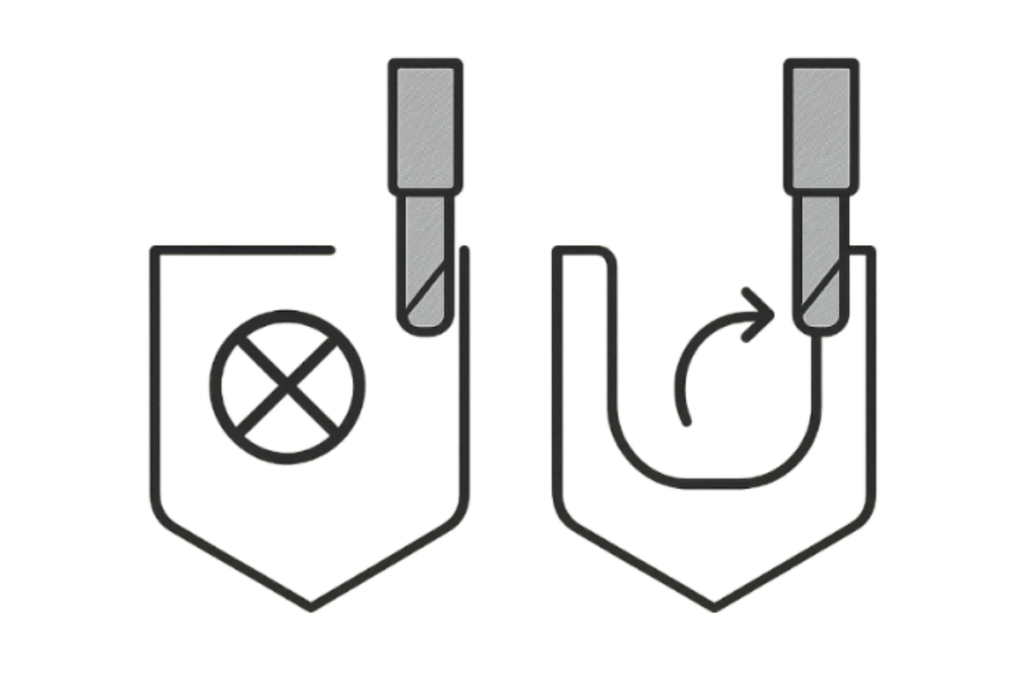
- The Fix: Always design internal corners with a radius (rounded edges).
- The Benefit: Your parts will be produced faster, tools won’t break, and your costs will drop.
Material Matters: How Picking Aluminum vs. Steel Can Triple Your Cost
Just as the shape of your part affects the price, the block of material it’s made from can have an even bigger impact. Imagine trying to slice through a stick of firm butter versus carving a block of dense oak wood. You’d have to move much more slowly and carefully with the wood. CNC machines face a similar reality, and the time they spend is what you pay for.
This essential property is called machinability—a simple measure of how easily a material can be cut. Materials with good machinability, like aluminum, allow the machine to work quickly. Harder materials like stainless steel have poor machinability, forcing the machine to run dramatically slower to avoid breaking tools. This difference in material selection for precision machining can easily make a steel part two to three times more expensive than an identical one made from aluminum.
Unless your project has extreme strength or heat requirements, a great default choice is Aluminum 6061. It provides an excellent balance of strength and cost-effectiveness precisely because it’s so easy to machine.
The Bridge to Quality: 3 Critical Things Your Manufacturer Needs to Know
Beyond the design itself, the single biggest source of quality problems is a lack of context. Sending a 3D file to a machine shop without explanation is like handing a chef a list of ingredients without the recipe. To get the best results, you need to bridge the gap with clear communication, transforming your manufacturer from a simple operator into a knowledgeable partner.
To avoid costly errors and delays, always provide these three pieces of information with your design:
- The part’s primary function (“What’s its job?”).
- The most critical features and dimensions (“Where does it need to be perfect?”).
- Your project context (e.g., “Is this a one-off prototype or for a 1,000-unit run?”).
Providing this context is crucial. It allows a skilled machinist to focus precision (and your money) where it counts, while potentially suggesting cost-saving simplifications on non-critical areas. This simple act of communication invites valuable machinist feedback and ensures that the part you get back doesn’t just match the drawing—it accomplishes the mission.
Our Quality Pre-Flight Checklist
Before you send your next file, run this 30-second audit:
- [ ] Be Realistic: Did I use standard tolerances (±0.005”) where possible?
- [ ] Check the Corners: Are all internal corners rounded?
- [ ] Pick the Right “Material”: Is Aluminum 6061 sufficient for this version or do you need Stainless Steel?
- [ ] Provide Context: Have I told the shop what this part actually does?
This collaborative approach saves money, improves quality, and transforms you from a customer just buying a part into a partner making an idea a reality.
Tired of “black box” manufacturing? Let’s work together to optimize your designs for the best possible price and precision.