
The difference between a master calligrapher penning one invitation and an office printer churning out thousands perfectly illustrates the divide in metalworking. Machining is a form of subtractive manufacturing, carving final shapes out of solid blocks, much like a sculptor chipping away at wood.
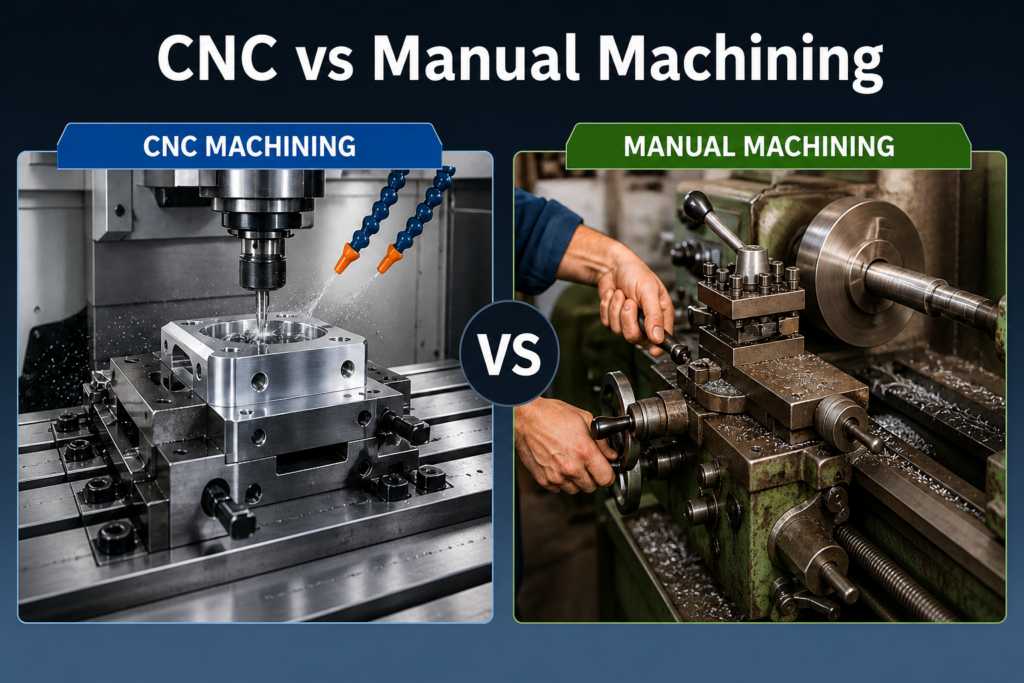
In practice, manual machining relies on human hands turning wheels. The craftsman uses tactile feedback—feeling the metal resist the blade—to guide their work. Conversely, the core CNC definition (Computer Numerical Control) simply means a computer acts as a GPS to automatically steer the cutting tools.
Weighing CNC vs manual machining isn’t about choosing new over old technology. A single, simple task is often faster to finish manually, but high-volume CNC machining excels at complex repetition. Ultimately, the primary goal is avoiding overpaying for the wrong process.
Why Manual Machining Still Wins for Custom Repair Work: The Low-Cost Secret of One-Off Parts
When needing one unique replacement part, firing up a robotic machine might seem smart, but automation hides a major cost: setup time. Before a computer-controlled cutter moves, someone must draw a digital blueprint using CAD (Computer-Aided Design) software. For just one item, paying for this digital prep work turns a simple fix into an expensive headache.
Alternatively, a skilled machinist can look at a broken component and start cutting metal immediately. This direct approach makes the cost-benefit analysis of conventional lathes highly favorable for quick fixes without software fees. The versatility of manual mills for custom repair work truly stands out in these common scenarios:
- Extracting and machining a broken bolt replacement.
- Drilling simple bracket holes for a custom shelf.
- Modifying existing parts to fit slightly different dimensions.
In any setup time comparison for one-off parts, human hands win the race before the computer even boots up. However, mass production entirely flips this dynamic.
Reducing Human Error with Digital Precision: How CNC Justifies Its Price Tag in Mass Production
When a project demands thousands of identical parts, human hands become a liability. Even master craftsmen tire, making minor mistakes over a long shift. Computer Numerical Control (CNC) takes over, acting as a flawless digital GPS for the cutting tool. By reducing human error in metal fabrication, these automated brains ensure part number five thousand perfectly matches part number one.
Think of “tolerance” as acceptable wiggle room; if a metal phone case is a hair too small, the device simply won’t fit. Hitting precision tolerances in automated metalworking is where CNC truly shines. The software calculates exact depths, delivering relentless repeatability that manual dials cannot guarantee across large batches.
Sculpting a smoothly curved, aerodynamic car rim is nearly impossible using conventional hand cranks. CNC machines utilize 3-axis movement—moving left-right, forward-backward, and up-down simultaneously—to carve intricate three-dimensional shapes. This digitally coordinated dance is also the secret to achieving superior surface finishes with automation, leaving polished, ready-to-sell products behind.
Because the computer handles the heavy lifting, factories can run “lights-out,” producing parts overnight without human supervision. This incredible labor efficiency makes mass production highly profitable, provided the production volume justifies the upfront programming costs.
The Setup Time Trap: Identifying the ‘Break-Even’ Point for Your Production Budget
Paying a chef to write a detailed recipe for a single burger is incredibly expensive. Yet, when feeding a stadium, that same recipe’s cost per burger drops drastically. This economies of scale concept drives manufacturing cost-benefit analyses. CNC machines run fast, but writing digital instructions demands heavy upfront setup time.
To find the break-even point, compare low volume prototyping vs mass production efficiency:
- 1 Unit: Manual wins. With zero setup, it costs $100 per part. CNC adds a $400 programming fee, totaling $500 per part.
- 10 Units: The break-even point. Manual stays $100 per part. CNC setup divided across ten items ($40) plus a $60 run time equals $100 per part.
- 100 Units: CNC dominates. Manual remains $100 per part. CNC’s setup fee practically vanishes, dropping the final cost to $64 per part.
This math reveals the true ROI of upgrading to computerized equipment. However, automated machines still require highly capable human oversight to operate properly.
Skills and Maintenance: CNC vs Manual Machining
Assuming computers do all the work is a costly mistake. The skills required for traditional machinists and CNC programmers contrast sharply; craftsmen rely on physical intuition, while digital operators use software logic. However, the best automated operators first learn on manual machines, because understanding metal’s physical limits is an essential foundation. Consequently, training time for conventional vs programmed machining shifts from developing years of muscle memory to mastering computer interfaces.
To bridge this gap, modern operators use G-Code. Think of G-Code as sheet music for a robotic orchestra, telling the machine’s motors exactly where to move and cut. Instead of paying someone to physically turn dials, you pay a technician to troubleshoot this digital sheet music and maintain expensive software licenses.
Even the smartest equipment requires physical care. The maintenance requirements for digital machine tools go beyond basic preventive maintenance like oiling gears. These automated systems demand routine digital calibration—ensuring the computer’s internal GPS perfectly matches physical reality. Accounting for these upkeep expenses is crucial for making an accurate production choice.
Your 3-Step Decision Plan: Matching Your Project to the Right Machining Method
Minimizing total costs requires matching the right machining method to the project’s specific parameters. Apply this decision tree to your next manufacturing requirement:
- How many? CNC is for mass production; manual is for one-offs.
- How complex? The advantages of automated milling over hand operation shine on intricate, three-dimensional geometries.
- How fast? Manual wins for immediate repairs with zero setup time.Planned production with repeat runs → CNC delivers efficiency.
Understanding the distinct strengths of both methods clarifies why conventional tools remain highly relevant today. Whether relying on artisan hands or computer brains, selecting the exact right tool for the job ensures efficiency, precision, and a healthy bottom line.
Not sure which process fits your part? Send us your drawing—we’ll help you evaluate and quote the best option.